Complete HARP Process Handbook
3-step recipe parameters / 28nm seam debug checklist / SiN pull-back sweet spot / H2 treatment window / platform selection / 16 process diagrams — available on the Paid Materials page. diamond-site.pages.dev (international) or semi-diamond.com (China).
HARP Gap-Fill Got a Seam? Don't Touch the Recipe Yet
If you work on STI/ILD HARP, you've probably been here: the line suddenly flags a seam defect, and the first instinct is to rush to the HARP chamber and ask, "Did anyone touch the recipe?" Changed? Not changed? Either way, let's tweak the O3/TEOS ratio and see.
Half a day later, the seam is still there, and a stack of wafers is scrapped.
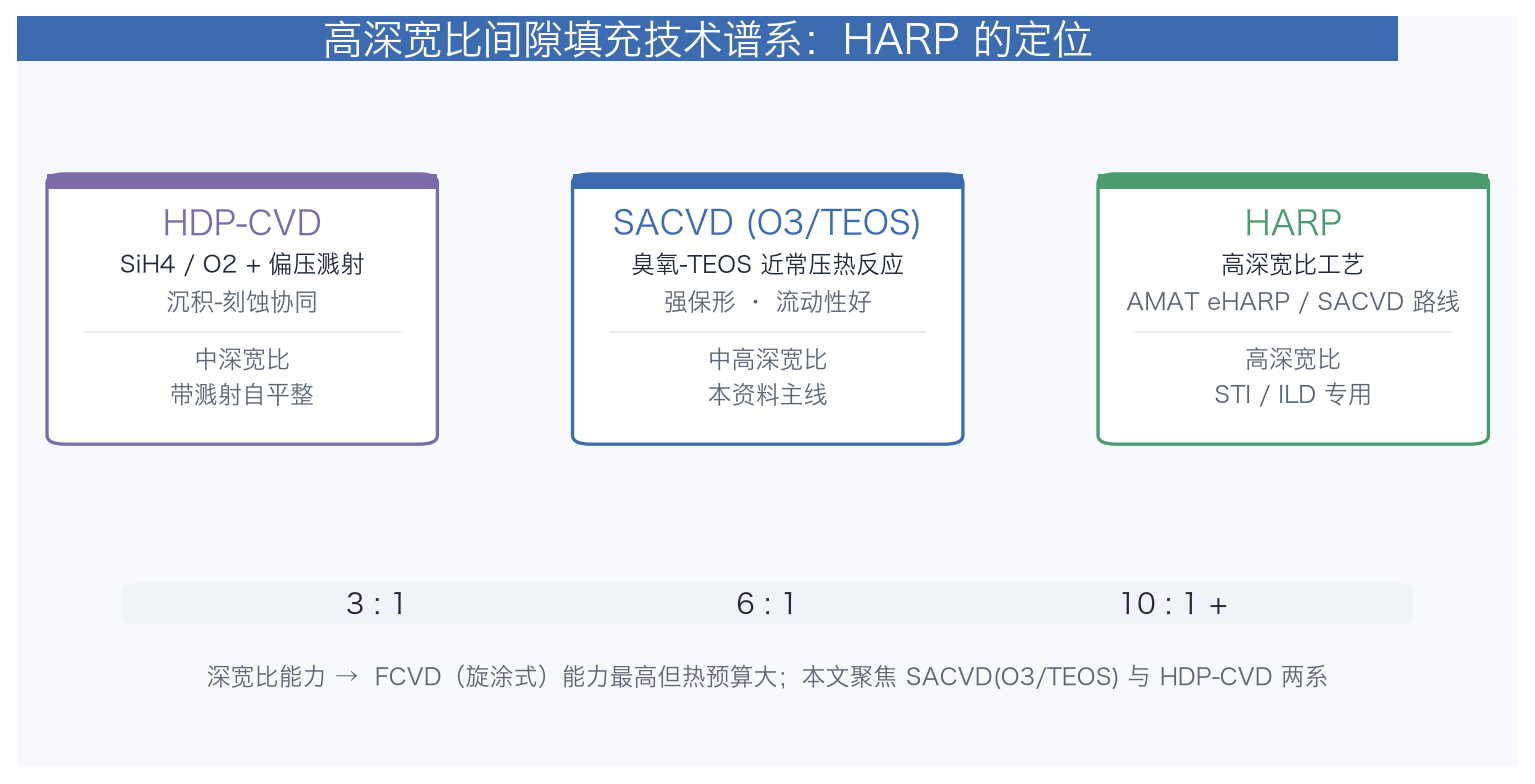
Why Tweaking the Recipe Doesn't Help
Here's the counter-intuitive part: when HARP shows a seam, the root cause is 80% not in the HARP chamber — it's upstream: trench profile, SiN pull-back amount, under-cut. You can spend hours tuning the HARP recipe, but you'd be better off going back to check the etch and wet strip steps.
There's an even sneakier trap: the same HARP recipe gives very different film thicknesses on different substrates. It's not recipe drift — it's substrate surface chemistry. Si and SiO2 surfaces have wildly different reactivity. You tune the recipe on a bare-Si monitor wafer, then move to production wafers with ISSG substrates, and the thickness range goes abnormal. How big is the gap? Which substrate combinations are the worst offenders? That's in the full handbook with measured data.
The Three Real Root Causes of Seam
At 28nm, seam is more sensitive than at 40nm. Break it down and the root cause usually falls into one of three buckets — none of which live in the HARP recipe itself. Which three? What's the improvement direction for each? What order should you debug them in?
All of this is written up in the complete HARP process handbook — it can't be done justice in a few sentences. The handbook covers the 3-step recipe parameters, 28nm seam debug checklist, SiN pull-back sweet-spot values, H2 treatment window, platform selection criteria, and 16 process diagrams.
The Hidden Switch: H2 Treatment
Many people overlook this: a pre-deposition H2 treatment on the STI liner directly affects gap-fill capability. The principle is about changing the surface bond type — but exactly how? What does it do to deposition rate? How do you tune the parameters? That's in the full handbook too.
Tuning HARP Isn't About Memorizing Recipes
The valuable skill isn't remembering a specific recipe — it's reading the interplay of "four ledgers": thermal conduction, morphology, recipe design, and stress. When you see abnormal thickness, can you tell if it's thermal or profile? When you see a seam, can you distinguish front-end from back-end? When stress goes sideways, can you tell if it's anneal or deposition?
How exactly do you read these four ledgers, how do you co-tune them, how do you build a debug flow? The full version is on the site.